Why CAN Bus Defenses Still Fail in 2026
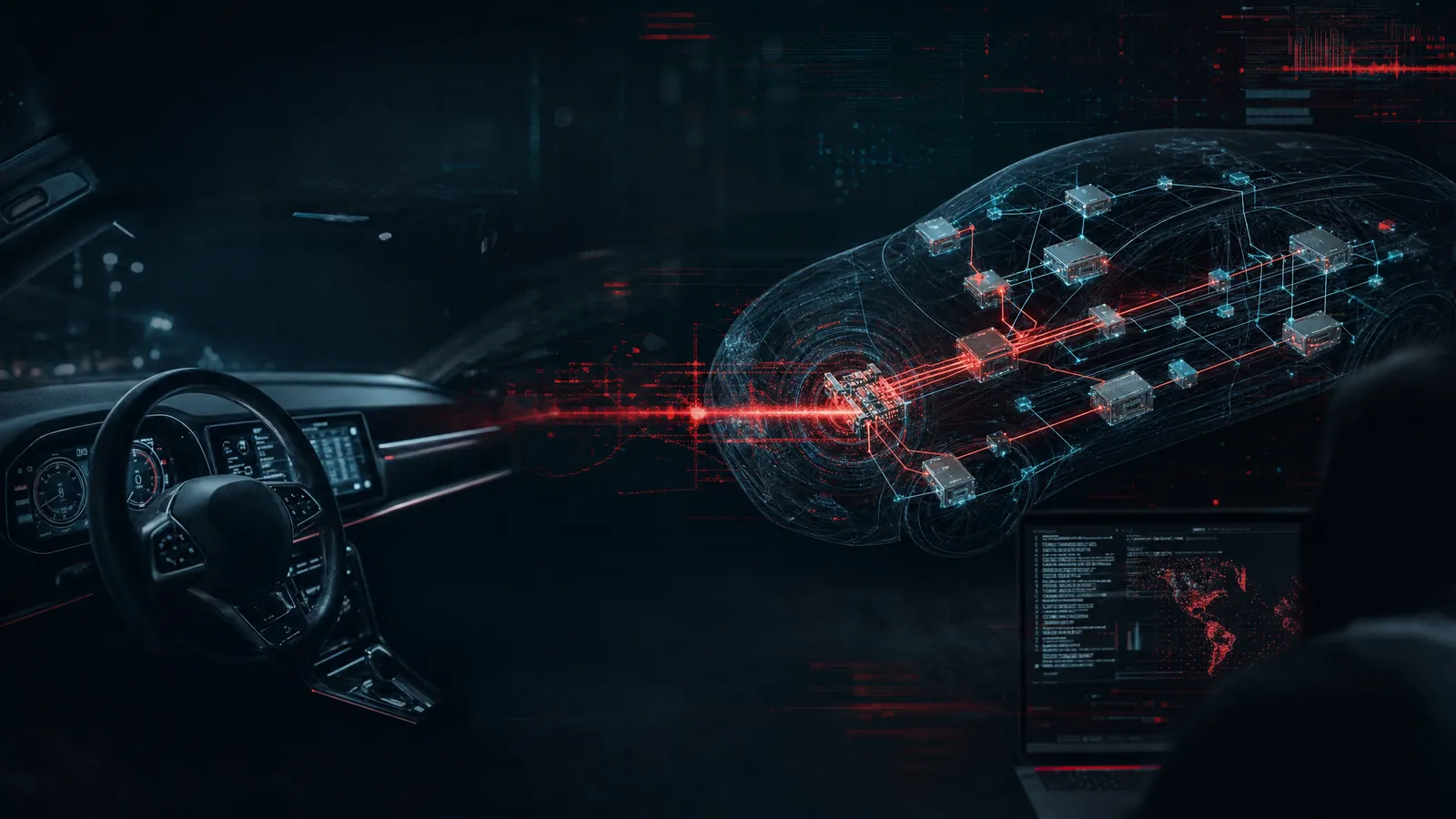
Modern vehicle security has a trust problem.
The Controller Area Network (CAN) bus still sits at the center of how many vehicles coordinate critical functions, but the protocol was never built with modern threat models in mind. It was built for reliability, simplicity, and timing.
That design tradeoff still matters today.
CAN has no native authentication, no built-in authorization model, and no meaningful confidentiality layer. So when an attacker reaches the right part of the vehicle network, the hardest part is often not creating malicious messages. The hardest part is gaining the foothold that lets those messages blend in.
That is why “just add detection” is not enough.
The mistake defenders keep making
A lot of automotive security discussion still treats the problem as if the CAN bus itself is the whole story.
It is not.
The real issue is architectural trust. If a vehicle network assumes that every message on the bus is probably legitimate, then any upstream weakness matters more:
- exposed diagnostic paths
- insecure gateways
- weak ECU isolation
- telematics exposure
- bad assumptions around message provenance
That is also why modern attacks often combine old and new paths. One weakness gets the attacker in. A trusted protocol helps them move.
What the recent research keeps telling us
The strongest lesson from recent automotive IDS research is not that detection is useless. It is that many defensive claims were built on easy or unrealistic data.
The can-train-and-test dataset is useful because it gives defenders a cleaner way to test whether an IDS can generalize across multiple vehicles and attack types.
The ROAD dataset analysis matters because it pushes toward more realistic evaluation with stealthier injections instead of overly convenient lab conditions.
And at the industry level, Upstream’s 2025 automotive cybersecurity report points to a broader shift: attackers are increasingly targeting telematics, APIs, cloud systems, and large-scale mobility infrastructure, not only the in-vehicle bus itself.
That should change how teams defend.
What good automotive defense looks like now
Strong vehicle security needs more than CAN visibility.
It needs:
- segmentation between critical and non-critical domains
- stricter gateway enforcement
- secure update and supply-chain discipline
- telemetry that helps investigators reconstruct attack paths
- testing against realistic attack datasets, not only toy benchmarks
In other words: stop defending a protocol in isolation. Defend the trust boundaries around the vehicle.
Why this matters beyond cars
This is one reason car hacking remains such a valuable lens for security professionals.
Vehicles make trust assumptions visible. Once you understand how insecure internal trust creates downstream risk in cars, you start seeing the same pattern everywhere else: IoT systems, industrial systems, APIs, and AI agents.
That is the operator mindset LufSec is building toward.
Also, subscribe for new breakdowns: LufSec on YouTube
If you want more practical offensive and defensive thinking, explore LufSec and start with Car Hacking 101.
Want the operator view?
If you want to understand how modern vehicle attacks really work, start with Car Hacking 101. It covers the real attack surface across CAN, telematics, key fobs, firmware, gateways, and connected-vehicle trust failures.