Why Vehicle Gateways Fail as Security Boundaries
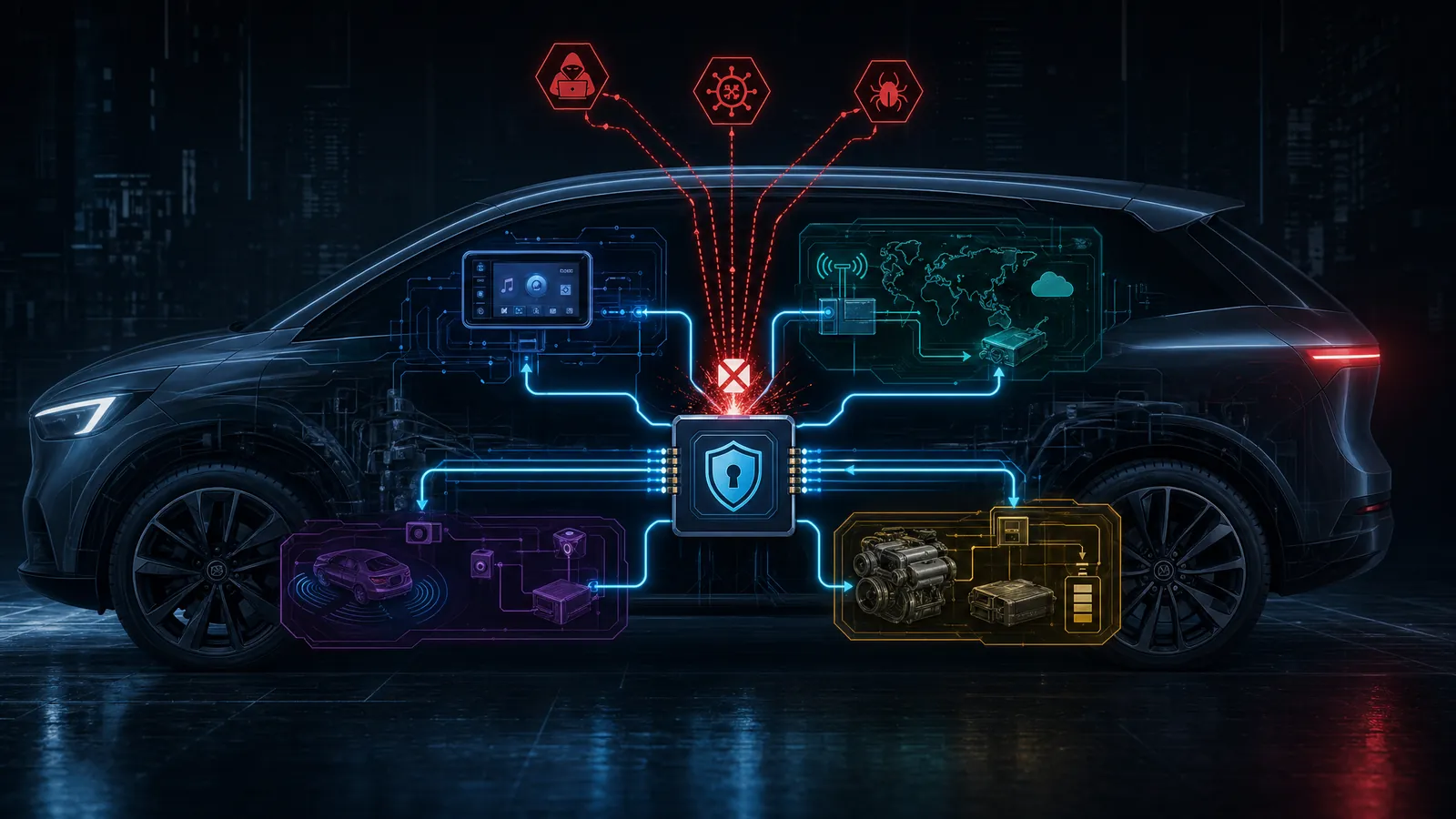
Modern vehicle platforms look more segmented than older designs, but that visual complexity can create false confidence. A gateway module does not become a security control just because it sits between networks.
If the gateway permits overly broad message flows, relies on weak trust assumptions, exposes diagnostic paths too freely, or fails to surface abnormal traffic, an attacker who lands on one ECU may still move farther than the architecture diagram suggests.
The dangerous assumption
Many teams treat gateways like proof of maturity. They see separate buses, domain boundaries, and centralized routing and assume lateral movement is now under control.
That assumption breaks fast when the enforcement logic is weak. A boundary only matters if it denies dangerous traffic, constrains who can talk to what, and makes abuse visible early.
What attackers actually test
Attackers do not audit the architecture slide. They probe for trust failures.
They look for paths like these:
- permissive cross-domain message forwarding
- diagnostic functions that reach farther than intended
- ECUs that can impersonate or flood trusted traffic
- weak monitoring around abnormal message timing or source behavior
- recovery workflows that favor uptime over containment
If any of those paths hold, the gateway can become a traffic director for the attacker instead of a blocker.
What stronger vehicle defense looks like
1) Enforce narrow message policy
Gateways should allow the minimum traffic required, not broad convenience paths that survive from integration or testing.
2) Treat diagnostics as attack surface
Diagnostics and maintenance workflows are useful, but they also create trusted pathways attackers love to inherit.
3) Add visibility, not just routing
If you cannot tell when an ECU starts speaking out of character, you are depending on luck after compromise.
4) Test for pivot paths explicitly
Security validation should ask how a compromised ECU could move sideways, not just whether each ECU looks secure in isolation.
Why this matters commercially
Software-defined vehicles turn architecture mistakes into brand problems. When lateral movement inside the vehicle is easier than the design team expected, the result is not just a technical issue. It becomes a trust, safety, and reputation issue.
Teams that want better automotive security need to measure gateways by what they block, what they detect, and how well they constrain attacker movement under pressure.
If you want the practical side of vehicle attack surfaces, message trust, gateway abuse, and how these paths actually get exploited, start with the LufSec Car Hacking course.
Further reading: Vehicle Security: Risk Assessment in Transportation and CAN-LOC: Spoofing Detection and Physical Intrusion Localization on an In-Vehicle CAN Bus Based on Deep Features of Voltage Signals.
Also follow LufSec on YouTube for more short-form breakdowns.