One Weak Vehicle API Can Unlock a Car
Car hacking is not just an in-vehicle problem anymore.
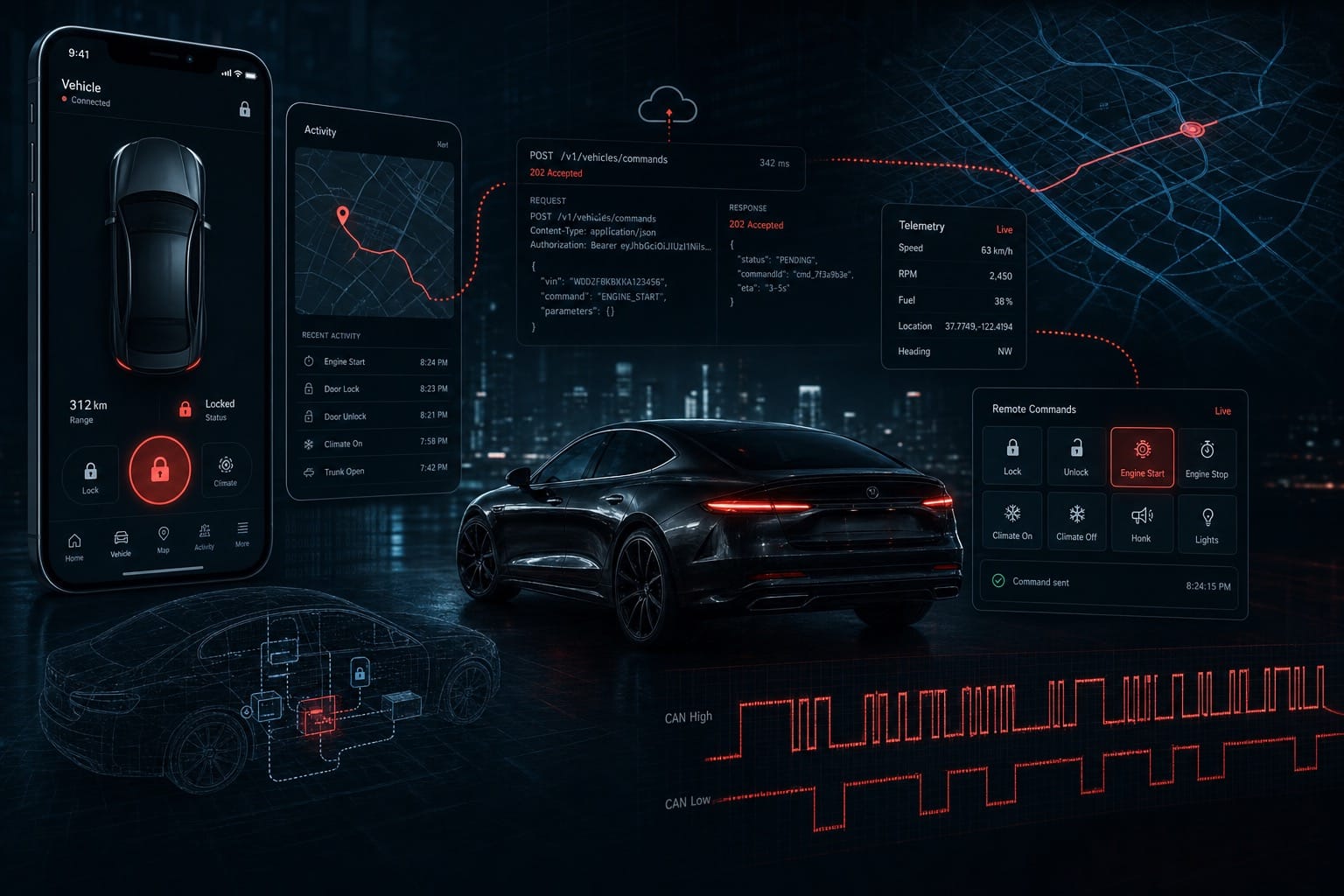
A lot of teams still focus almost entirely on the CAN bus, ECU trust, and diagnostic access. Those still matter. But the modern vehicle attack surface has widened, and the fastest-growing paths now sit outside the cabin: companion apps, telematics platforms, backend APIs, account-recovery flows, and remote command logic.
That shift shows up clearly in Upstream’s 2025 automotive cybersecurity reporting. The report says telematics accounted for 66% of incidents, and API-related attacks kept rising as vehicles and mobility systems pushed more functionality into cloud-connected services.
That is the part defenders keep underestimating.
The mistake teams keep making
A lot of automotive security programs still defend the vehicle like the attack begins on the bus.
Sometimes it does.
But if weak API authentication, sloppy session handling, broken ownership flows, or over-trusted mobile commands let an attacker reach remote functions first, then the in-vehicle network becomes only one step in a larger chain.
That is why modern car hacking has to be modeled as a trust-chain problem, not only a protocol problem.
The risk is not just “someone can send bad CAN messages.”
The risk is that an attacker may never need to start there.
Five tests to run before you trust a vehicle API
1. Test authentication like an attacker, not like a happy-path user
Check whether mobile and web flows enforce strong authentication consistently across login, token refresh, password reset, and device re-registration. Weakness here can become remote vehicle access fast.
2. Test ownership and account-binding logic
If an attacker can rebind a vehicle, abuse support flows, or manipulate identity checks, they may not need an exploit in the vehicle at all. They only need control over who the platform thinks owns it.
3. Test remote-command authorization separately from basic app access
Unlock, start, locate, climate, and charging actions should have tighter checks than generic account reads. If every authenticated session gets too much power, a stolen session becomes a vehicle-security incident.
4. Test API exposure as part of the full telematics path
Inspect backend endpoints, mobile traffic, rate limits, token scope, logging behavior, and privilege boundaries. The question is not whether the API responds. The question is whether it trusts too much.
5. Test pivot paths from remote access into the vehicle trust boundary
A remote foothold matters more when it can trigger privileged workflows, dealer actions, firmware processes, or other paths that influence the vehicle’s real-world behavior.
Why this matters now
This is exactly why car hacking training has to evolve beyond a narrow CAN-only mental model.
The strongest operators understand both sides of the problem: the in-vehicle network and the cloud-app-telematics chain that now surrounds it.
That is also the gap LufSec can help close.
If you want hands-on automotive security training that matches how the attack surface actually looks today, start with Car Hacking 101: From Key Fob Cracking to Full System Exploitation.
For a broader industry signal, read Upstream’s analysis of the latest automotive cybersecurity report. For the research side, CAN-focused work like can-train-and-test and CAN-QA is useful because it keeps reminding defenders that protocol-level visibility alone is not enough without realistic reasoning and testing.
And if you want more operator-grade breakdowns across AI hacking, car hacking, and IoT hacking, join the newsletter at LufSec and follow LufSec on YouTube.
Want the operator view?
If you want the practical foundation behind modern vehicle attack paths, start with Car Hacking 101. It is built around the real attack surface across APIs, telematics, CAN, RF, gateways, and trust-chain failures.