Prompt Injection Is Now an Agent Breach Path
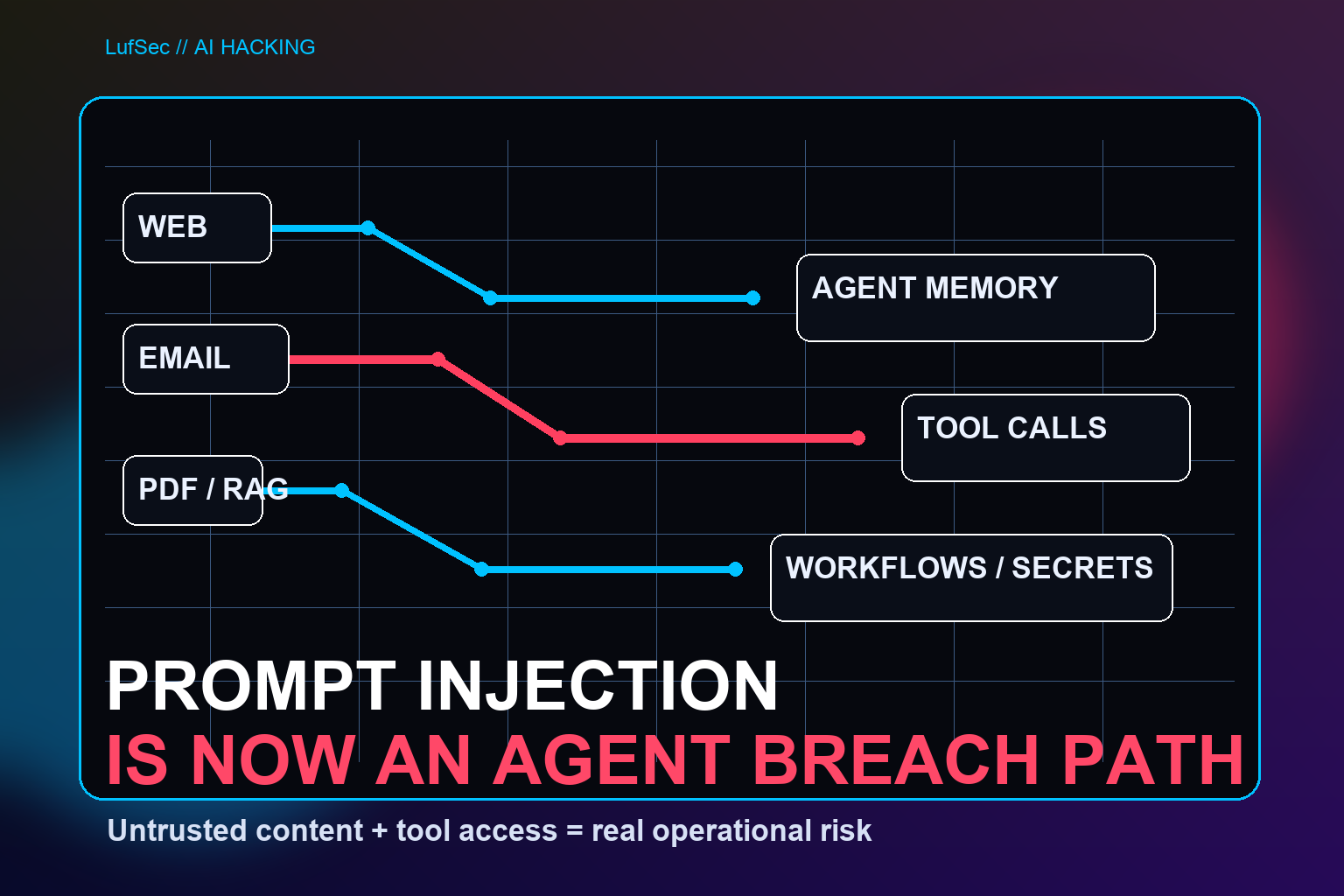
Prompt Injection Is Now an Agent Breach Path
Most teams still talk about prompt injection as if it is mostly a model-behavior problem.
That framing is now too small.
The better way to look at it is this: prompt injection is becoming the easiest path from untrusted content to unauthorized agent behavior. Once an LLM is connected to tools, secrets, workflows, or business systems, the question stops being “Can someone confuse the model?” and becomes “What can the system do after the model is confused?”
That shift matters because the market is already moving. A recent enterprise security write-up in https://biztechmagazine.com/article/2026/04/prompt-injection-attacks-llm-security-risk-it-leaders-must-address-perfcon treats prompt injection as one of the most important AI security risks leaders need to address. Meanwhile, current arXiv work is drilling into indirect prompt injection in the wild and defenses for tool-using agents, including https://arxiv.org/abs/2604.27202 and https://arxiv.org/abs/2604.24118.
Competitors are moving the same way. Promptfoo is leaning hard into indirect prompt injection testing and agent red teaming, while Lakera is framing agent security around runtime controls and outcome control. That is a signal worth paying attention to. The market is steadily abandoning the fantasy that better prompting alone is enough.
What actually changed
Old mindset:
- Prompt injection is a jailbreak problem.
- We need stronger system prompts.
- Maybe we add a few filters.
New reality:
- Prompt injection is a trust-boundary problem.
- Indirect prompt injection is often more dangerous than direct attacks.
- Agents can read, decide, call tools, and act with privileges.
- That turns a text-manipulation issue into an action-and-data security problem.
If your agent can browse the web, read a ticket queue, summarize emails, search documents, or trigger downstream automations, then every one of those surfaces can become part of the attack path.
Why AI agents raise the stakes
A normal chatbot can say something dumb.
An agent can do something expensive, irreversible, or embarrassing.
That is the difference.
The moment a model can access customer data, internal documents, cloud systems, payment flows, repositories, or messaging tools, prompt injection starts looking less like content moderation and more like access control failure. If an attacker can smuggle instructions into a document, page, or retrieved chunk that the model later treats as relevant guidance, the model may carry those instructions across a boundary you never intended it to cross.
That is why so much of the new research is now focused on architecture. The real question is no longer just “How do we make the model say no?” It is “How do we stop the model from having enough authority to hurt us when it says yes?”
The controls that matter most
1) Least privilege for agent tools
Do not give broad read, write, send, purchase, delete, or admin powers unless the workflow truly needs them. Most agent systems are over-permissioned from day one.
2) Hard trust boundaries between instructions and data
Untrusted content should never be blended casually into high-authority system context. Treat retrieved text, webpages, tickets, PDFs, and inbound messages as hostile until proven otherwise.
3) Output validation before action
Model outputs should be treated as unsafe intermediate material. Before any action is taken, validate what the model is trying to do and whether it fits the allowed workflow.
4) Approval gates for high-impact actions
Anything involving money, secrets, external communication, account changes, or production systems should hit a human approval boundary.
5) Tracing and auditability
You need a clear record of what the agent read, what it decided, and what it attempted. If you cannot reconstruct the chain, you do not really control the system.
The sales lesson hidden inside the security lesson
This is exactly why AI security is becoming a better commercial category every month.
More teams are shipping agents. More workflows are being connected to tools. More businesses want automation quickly. That combination creates urgency, fear, and budget. The people who can explain the difference between a prompt problem and an authority problem will win attention because they are speaking to what buyers are already feeling.
That is also the content opportunity for LufSec.
The strongest AI Hacking content right now is not generic “AI is risky” noise. It is practical, operator-grade content that shows where trust boundaries fail, how agent abuse actually happens, and what defenses change outcomes in real deployments. That is where authority gets built, and it is where course sales make sense because the pain is concrete.
What smart teams will do next
The best operators are going to make four moves over the next quarter.
First, they will narrow agent permissions aggressively. Second, they will separate trusted orchestration from untrusted content ingestion. Third, they will add verification layers between model output and tool execution. Fourth, they will stop treating AI security as a compliance checkbox and start treating it like product reliability.
That matters commercially because buyers do not want abstract AI safety language anymore. They want to know whether their copilots can leak data, trigger bad actions, or quietly expand risk inside normal workflows. The educator or brand that can explain those failure modes clearly and show defenses that actually map to deployed systems will win more trust than the brand still posting generic fear headlines.
This is exactly the lane LufSec should own: practical AI Hacking education for people who are moving from experimentation into real deployment. Not shallow prompt tricks. Not vague policy talk. Real operator knowledge that helps teams test, break, and defend the systems they are actually building.
If you want a practical foundation for prompt injection, agent abuse, trust boundaries, and real defenses, Start here: AI Hacking for LLMs.
Want the operator view?
If you want a practical foundation in prompt injection, agent abuse, trust boundaries, and real defenses, start with Introduction to Prompt Hacking for LLMs.